PXDepth
Ours
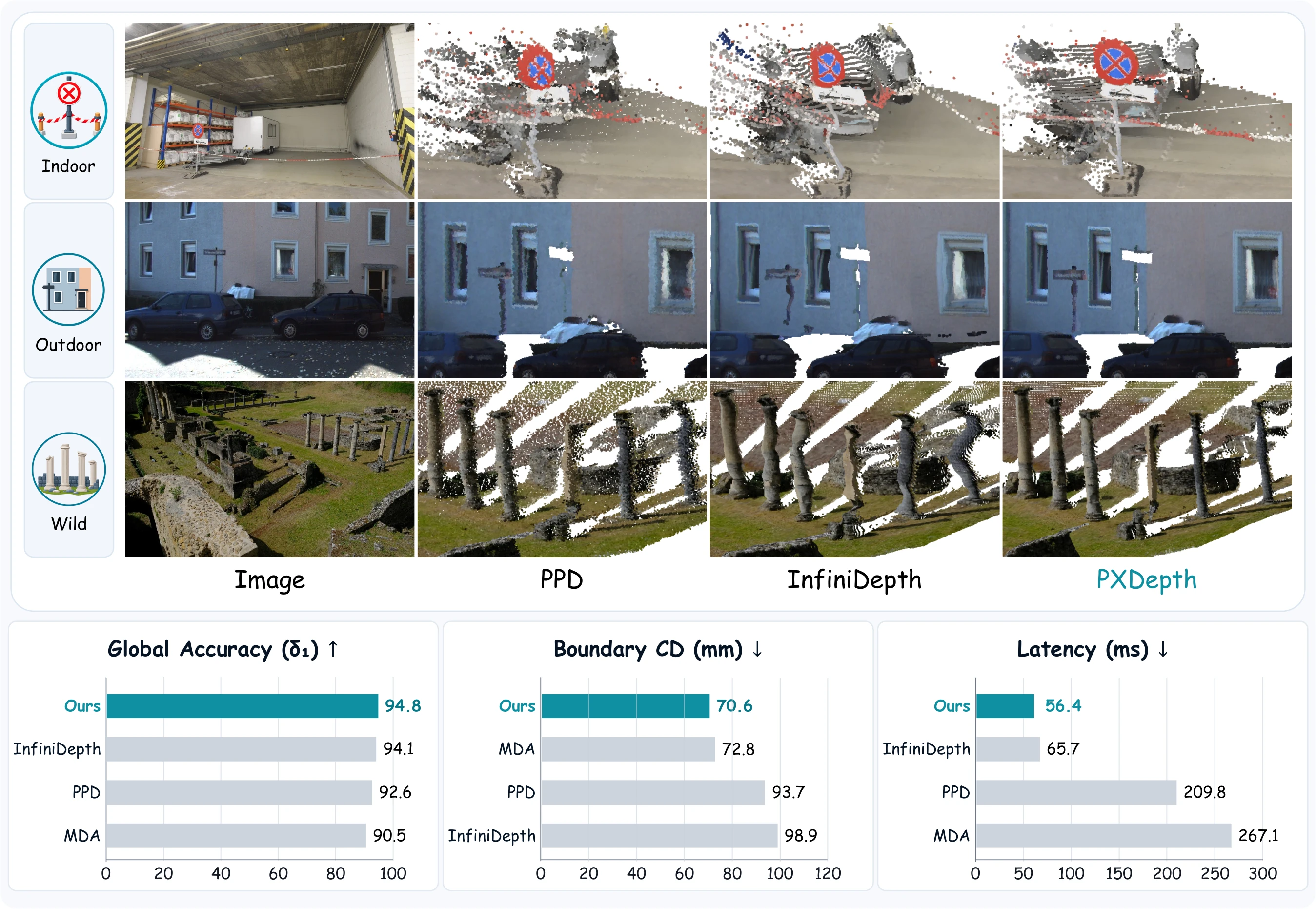
TL;DR: PXDepth separates global context encoding from pixel-space depth prediction, using a Global Context Encoder and a Pixel-Space Depth Predictor.
Qualitative Visualization
Baseline
Rotate left drag
Zoom wheel or pinch
Pan right drag or Shift-drag
Focus double click
Adjust align one view, then Done
Reset R or button
Choose a scene
Staircase
9 / 14
Hover for a larger RGB preview
Overview
Comparison To Existing Architecture
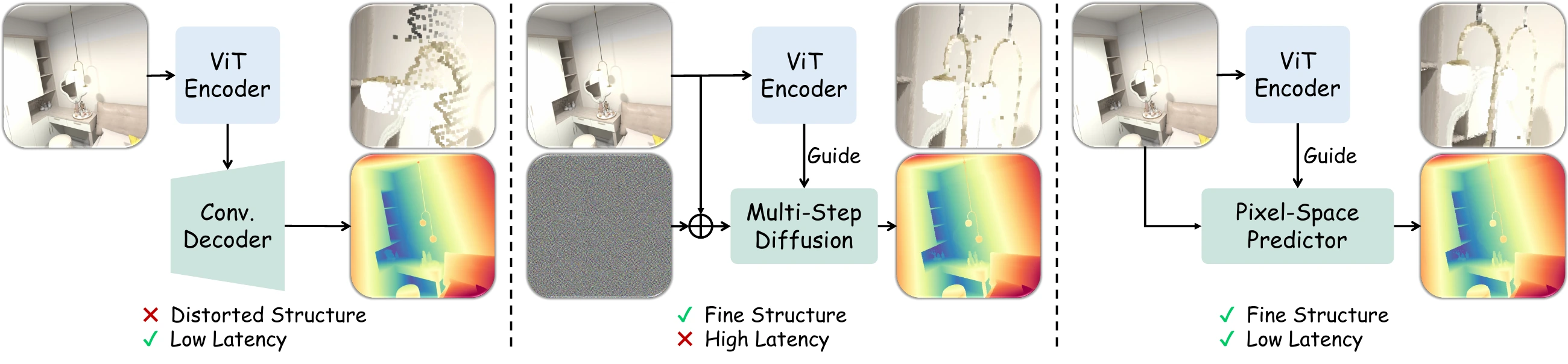
(a) Discriminative Architecture
(b) PPD
(c) Ours
Discriminative models. A large-patch ViT captures global context, while a convolutional decoder upsamples its low-resolution features in a single feed-forward pass. This is efficient, but coarse tokenization weakens high-frequency cues that upsampling may not fully recover, leading to distorted local structures.
PPD. Pixel-space diffusion, semantic guidance, and a cascaded DiT preserve high-frequency information and improve fine structures. However, multi-step denoising repeatedly evaluates the network, resulting in high latency.
PXDepth. A Global Context Encoder supplies scene-level geometry, while a CM-PiT-based Pixel-Space Depth Predictor maintains pixel-space features with coarse-to-fine compaction. This single-pass design preserves local structure while maintaining low latency.
Qualitative Comparison

Image
MoGe-2
MDA
PPD
InfiniDepth
Ours
Quantitative Comparison
| Category | Method | MoGe Benchmark | MDA Benchmark | Latency ↓ | |||
|---|---|---|---|---|---|---|---|
| Rel ↓ | δ₁ ↑ | Rel ↓ | δ₁ ↑ | Boundary CD ↓ | |||
|
Global Prediction |
DA V2 | 8.0 | 93.0 | 4.7 | 96.5 | 112.8 | 55.3 |
| DepthPro | 6.7 | 93.6 | 3.9 | 97.0 | 106.4 | 206.8 | |
| MoGe-2 | 5.1 | 95.6 | 3.5 | 96.9 | 100.3 | 32.9 | |
|
Structure Aware |
InfiniDepth | 7.2 | 94.1 | 4.7 | 96.7 | 98.9 | 65.7 |
| PPD | 7.5 | 92.6 | 4.4 | 96.5 | 93.7 | 209.8 | |
| MDA | 8.2 | 90.5 | 3.6 | 96.7 | 72.8 | 267.1 | |
| PXDepth | 5.8 | 94.8 | 3.6 | 97.0 | 70.6 | 56.4 | |
Rel and δ₁ measure global depth accuracy, while Boundary CD measures boundary sharpness. Boundary CD is reported in millimeters (mm). Latency is measured per image at 518 × 518 on an RTX 5880 GPU and reported in milliseconds (ms).
BibTeX
@misc{yuan2026pxdepthpixelspacemodelingstructure,
  title={PXDepth: Pixel-Space Modeling for Structure Preserving Monocular Depth Estimation},
  author={Zhiyuan Yuan and Guanying Chen and Lingteng Qiu and Ruimao Zhang and Shuguang Cui and Xiaochun Cao},
  year={2026},
  eprint={2608.16984},
  archivePrefix={arXiv},
  primaryClass={cs.CV},
  url={https://arxiv.org/abs/2608.16984},
}